King Charles the First's head
David CopperfieldKing Charles the First's head is the persistent image around which Mr. Dick's thoughts repeatedly become entangled. He connects the execution of Charles in 1649 with the trouble in his own mind, imagining that some of the king's difficulties were put into his head after the king's had been removed. The image frustrates Mr. Dick's efforts to make sense of his past, yet Aunt Betsey recognizes it as his allegorical way of expressing a real disturbance. Its recurrence shapes both his unfinished writing and the novel's portrayal of his unusual mind: what seems at first a comic historical confusion also gives his suffering a form he can return to and try to manage.
The Image and Mr. Dick's History
Mr. Dick's explanation joins a public historical fact to a private experience he struggles to articulate. When he asks David Copperfield the date of Charles's execution, he accepts 1649 as the date given by books but cannot reconcile it with his own sense of time. His question is not simply about chronology: he wonders how people around the king could have transferred trouble from the king's head into his own after the execution. The gap between the historical date and Mr. Dick's personal distress is precisely what he cannot resolve.
Aunt Betsey supplies the interpretation that Mr. Dick himself cannot make explicit. She explains that the king's head is an allegorical figure for the agitation connected with his illness. Mr. Dick had a kind sister, but her marriage made her miserable; his fear of his brother and sense of that brother's unkindness also weighed on him. The combined distress brought on a fever before Mr. Dick came to live with Aunt Betsey, and its memory remains oppressive. The historical image thus does not erase the human circumstances behind his suffering. It gives those circumstances an indirect, recurring expression.
Aunt Betsey's account also resists the assumption that Mr. Dick's manner should disqualify him from being understood or cared for. She considers him friendly and amenable, insists that she is willing to look after him, and says that nobody knows his mind as she does. Her defense of him is practical as well as affectionate: she has taken him into her home and recognizes that his peculiar way of speaking is part of how he conveys what happened to him. The image is consequently both a symptom of distress and a language his closest protector can interpret.
The Memorial and the Repeated Interruption
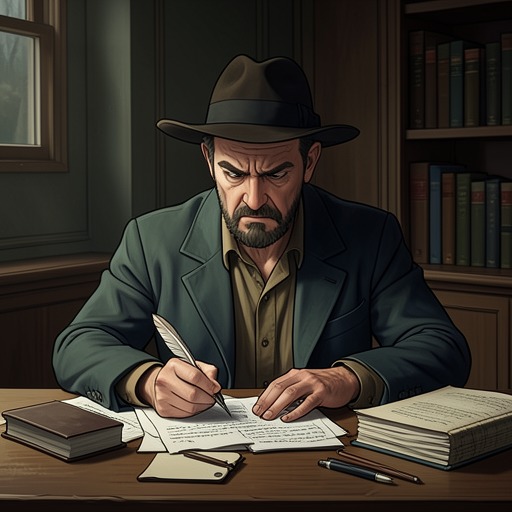
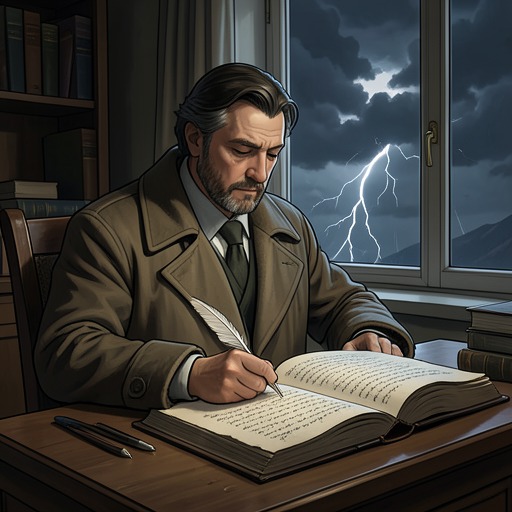
The image's most sustained recurrence is in Mr. Dick's attempt to compose a Memorial concerning his affairs. He works at it every day, intending it for a high official, but cannot keep King Charles the First's head out of the document. The historical figure eventually strays into the writing, throws it out of shape, and leads Mr. Dick to set that version aside and begin again. Aunt Betsey has specifically insisted that the image should not appear in the Memorial, because it is neither a businesslike nor a worldly way of describing his affairs. Her instruction, however, cannot stop the pattern: for upwards of ten years he tries to exclude it, and it continues to return.
That repetition makes the Memorial an emblem of effort without completion. Mr. Dick is patient and hopeful, and he works hard, but the writing never progresses toward a finished document. He does not seem to know what would happen to the Memorial if it were completed, or where it would go. Its practical purpose remains obscure even as its failure becomes predictable. The image is therefore not only an obstacle within the document; it reveals the distance between the formal, orderly account Aunt Betsey wants and the associations that continually occupy Mr. Dick's mind.
The recurring interruption is narrated with sympathy as well as humor. David observes Mr. Dick's mild awareness that something is wrong with the intrusion and his repeated, feeble efforts to keep it out, followed by the certainty of its return. The failed Memorial might look like a simple joke about distracted authorship, but its persistence gives the scene a more affecting rhythm: work begins, the image reappears, and the work is discarded. Mr. Dick's patience does not cure the pattern, but it shows how steadily he bears disappointment.
Kite-Flying and a Change of Register
The image is not confined to the failed manuscript. Mr. Dick sometimes pastes leaves from abandoned Memorials onto a great kite, believing that the kite carries their statements abroad. David allows that this belief may at times be a fancy, but he distinguishes it from the calm Mr. Dick finds while flying the kite. As it rises and pulls against the string, Mr. Dick appears serene; when it descends and lies on the ground, he seems to return gradually from a dreamlike state. The kite does not complete or correct the Memorial. Instead, it changes the terms of the recurring failure: discarded pages become part of an activity in which Mr. Dick can find peace.
David's description makes the kite a counterpoint to the Memorial. In the room, the historical image repeatedly draws the writing back into confusion. Outside, looking upward as the kite rises, Mr. Dick seems lifted beyond that confusion for a time. David imagines that the kite carries his mind into the sky, but the account marks this as the boy's impression, not as a factual explanation of Mr. Dick's condition. When kite and flier come back down together, the contrast ends; the calm is temporary, not a cure. This movement from interrupted writing to quiet attention gives the recurring image both comic persistence and emotional weight.
Recurrence in Mr. Dick's Social Life
King Charles the First's head also surfaces in Mr. Dick's conversations beyond the Memorial. On a Wednesday, he tells David about a man who hides near the house and frightens Aunt Betsey, then tries to place the first appearance of this man by referring again to 1649. He remains puzzled that he could be connected to a date so far in the past. The episode shows how readily the historical association enters his account of a different concern; it does not, by itself, explain the mysterious man's connection to Aunt Betsey.
At school, the image can briefly recede. Mr. Dick is happiest on his Wednesday visits, becomes a favorite among the boys, and takes a lively interest in their games, though kite-flying is the only game in which he actively participates. He can cheer the boys at hare and hounds or watch marbles, tops, cricket, and sliding with absorbed delight, oblivious for a time to the king's head and its attendant trouble. Those scenes prevent the recurring expression from defining all of him. It marks an enduring difficulty, but the novel also presents a sociable, inventive man whose pleasures and attachments are larger than that difficulty.
The expression's significance lies in this double movement. King Charles the First's head repeatedly returns, interrupts, and defeats Mr. Dick's attempt to put his affairs into conventional written order. Yet Aunt Betsey reads the association as a meaningful allegory, and David's account shows the persistence, imagination, and temporary serenity intertwined with it. The image is at once an obstacle to completion and the distinctive form through which Mr. Dick's troubled history remains present.